
How a heat pump works in your home: lukewarm radiators, steam from the outdoor unit, legionella, frost and the right settings. Short explanations with drawings. Your question not here? See the frequently asked questions or email us.
Background from the handbook our technicians use on site. It explains; it is not a guide to install yourself. The manufacturer's installation instructions and NEN 1010 always come first.
Common questions after the installation
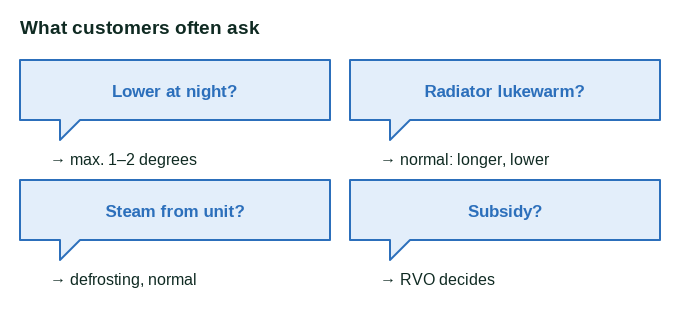
May I turn the thermostat down at night?
- Preferably not much, 1 to 2 degrees at most. A heat pump is most efficient when it runs steadily.
My radiators feel lukewarm. Is that right?
- Yes. A heat pump heats with water that is less hot, but for longer. Your home still gets warm, just more gently.
There is vapour coming out of the outdoor unit.
- That is defrosting: normal in cold, damp weather. See "Defrosting" below.
What does it cost per month in electricity?
- That depends on your home and the weather. A rough estimate: 1000 m³ of gas for heating is about 8800 kWh of heat; a heat pump with an SCOP of 3.5 needs about 2500 kWh of electricity for that. We cannot promise a fixed amount.
Do I get a grant?
- You apply for ISDE at RVO with our installation invoice, or we do it for you with the RVO application service. RVO decides on your application.
What do I do in case of a fault?
- Write down the code, take a photo of the display and contact us, or ask your question in My file. Never work on the refrigerant circuit yourself.
Radiators at low temperature
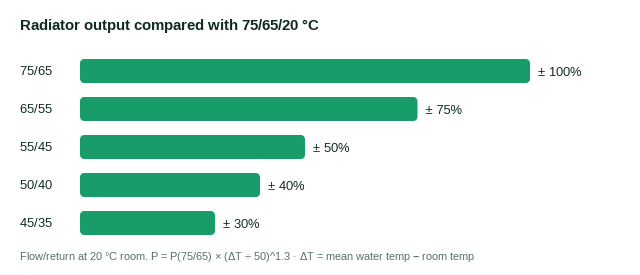
Output at lower temperature
Radiators are usually rated at 75/65/20 °C. With a heat pump the water is much cooler, so they give off less heat.
Rule of thumb (relative to 75/65/20):
- 55/45 → ± 50%
- 50/40 → ± 40%
- 45/35 → ± 30%
Formula: P = P(75/65) × (ΔT ÷ 50)^1.3, where ΔT = average water temperature − room temperature.
What this means in the home
- Room does not get warm at a low flow temperature → radiator too small: higher heating curve (lower efficiency), larger or extra radiator, or radiator fans.
- Balance and bleed the system first, only then draw conclusions.
Underfloor heating
- Works well at low temperature (flow often 30–35 °C).
- Set the flow meters per circuit; maximum flow temperature according to the floor/floor covering (wood!).
Defrosting, vapour, ice and noise
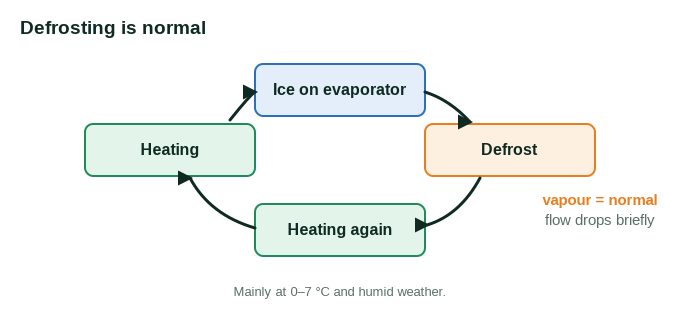
Defrosting
- At temperatures around 0–7 °C and in damp weather the evaporator freezes up. The unit then defrosts: it reverses the refrigerant circuit.
- You then see vapour/steam coming from the unit and water underneath it. That is normal (not a fire).
- During defrosting there is briefly no heat; the flow temperature drops for a short time.
Ice
- Condensate must be able to drain away. If it freezes under the unit: improve the drainage (gravel, drain pipe with heating cable if the manufacturer mentions it).
- Thick layer of ice on the evaporator that does not go away = fault or too little airflow: manufacturer/service.
Noise
- Legal noise requirement for installations such as heat pumps: ± 40 dB(A) at the neighbours' property boundary (Bbl). Check the current rule if in doubt.
- Vibrations: flexible hoses, rubber feet, not against a thin outer wall.
- Whistling/rushing in the pipes: air or too high a flow velocity.
Running your heat pump efficiently
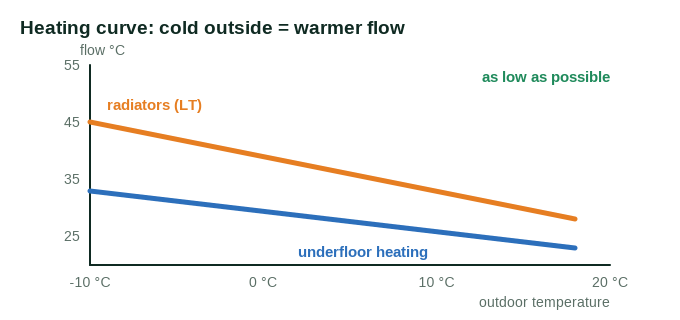
The heating curve
- The heating curve sets how warm the water to your radiators or floor is, depending on the outdoor temperature. Lower is more economical: every degree less saves a few percent of electricity.
- We set it at the handover. Too cold in severe frost, or too warm everywhere? Let us know and we will adjust it.
The thermostat
- Keep an even temperature. No big night setback: 1 to 2 degrees at most.
- If you use a quiet mode or night mode, make sure your home stays warm enough.
Hybrid heat pump
- Your boiler helps out when it is very cold outside, or when that is cheaper. We agree with you at the handover when that happens.
Heat pump water heater
- Leave the legionella programme switched on (see "Legionella").
A fault
- The fault code is shown on the display or in the app of your heat pump. Write it down and contact us.
Quick heat loss estimate
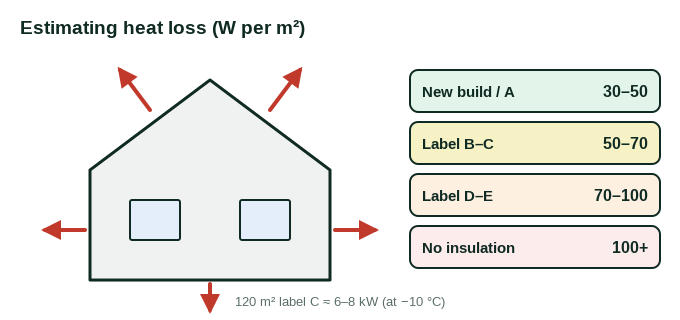
Rule of thumb per m² of floor area (at -10 °C outside)
- New build/label A: ± 30–50 W/m²
- Label B–C: ± 50–70 W/m²
- Label D–E: ± 70–100 W/m²
- Older home without insulation: 100 W/m² or more
Example: 120 m², label C → ± 6–8 kW.
Check with the gas consumption
- Annual gas consumption for heating (m³) ÷ ± 300–350 ≈ required output in kW for a home with normal heating habits.
- Example: 1800 m³ (of which ± 1500 m³ for heating) → ± 4.5–5 kW.
Note
- This is an estimate to see whether a unit is clearly too small or too large. We do not sell heat pumps; the choice is up to the customer or their adviser.
- Too small = a lot of backup heating; too large = a lot of switching on/off (short cycling).
Legionella and hot water
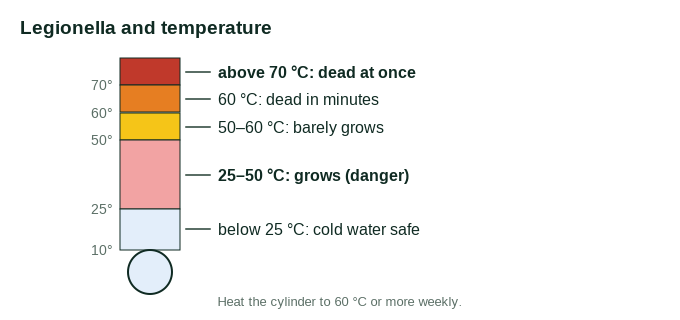
Legionella in brief
- Grows between about 25 and 50 °C, fastest around body temperature.
- Above 60 °C legionella dies within a few minutes, above 70 °C almost immediately.
- The risk is in lukewarm, stagnant water: dead legs, rarely used taps, a cylinder that never gets hot.
Heat pump water heater and storage cylinder
- Switch on the legionella programme: at least weekly, the whole cylinder to 60 °C or more.
- Do not leave dead legs in place; flush rarely used taps regularly.
- Preferably keep cold water below 25 °C (do not route pipes past warm parts).
Scalding
- At 60 °C or more at the tap: recommend a thermostatic mixing valve (children, elderly people).
Refrigerant R290 (propane)
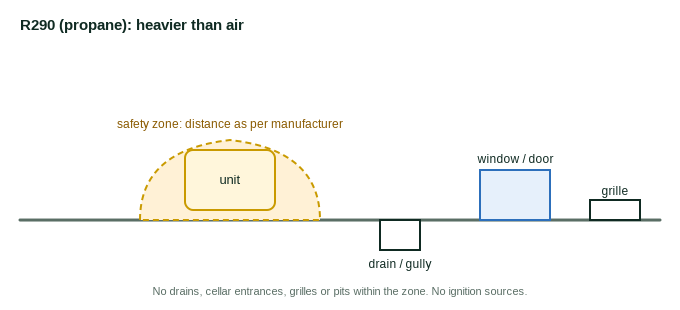
What you need to know
- R290 is propane: flammable and heavier than air. It sinks to low points.
- A monobloc is factory-filled; you do not open the refrigerant circuit.
Placement
- Keep the distances specified by the manufacturer to pits, drains, basement entrances, ventilation grilles and windows/doors.
- No placement in a hollow or enclosed corner where gas can linger.
During the work
- No open flames or sparks near the unit; electrical work with the power off.
- If you smell or hear something at the refrigerant circuit: switch off the power to the unit, keep your distance, call the manufacturer/service.
Frost protection: anti-freeze valves or glycol
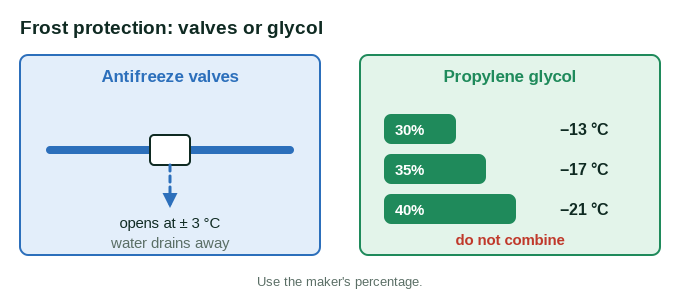
Anti-freeze valves
- Open at a water temperature of around 3 °C and let water drain so the outdoor pipe does not freeze.
- Do not combine with glycol.
- During a power cut in frost, water can run out; the system must then be topped up.
Glycol
- Use propylene glycol (non-toxic), not ethylene glycol (car).
- Rule of thumb for the freezing point of propylene glycol: 30% ≈ -13 °C, 35% ≈ -17 °C, 40% ≈ -21 °C.
- Glycol slightly reduces efficiency and flow rate; stick to the percentage the manufacturer specifies.